Unctuous and Cloudy: How to Make the Ultimate Multi-Bone Meat Stock

A Deep and Flavorful Foundation: Multi-Bone Meat Stock
The most satisfying stocks come from variety and this meat stock recipe is no exception. Chicken feet are packed with collagen, giving the broth its signature viscosity and a silky mouthfeel. Chicken carcasses add a subtle, roasted-chicken depth even when unroasted. Pork bones bring sweetness and roundness to the flavor profile, while beef bones add bold umami and minerality.
This combination also contributes to the meat stock’s cloudiness. In this case, cloudy isn’t a flaw—it’s a feature. That milky look means the fats, proteins, and collagen have emulsified into the liquid. It’s the same principle that gives tonkotsu ramen broth its richness. With each sip, you’ll taste multiple layers, each coming from a different type of bone.

Low and Slow: The Cooking Method That Transforms Bones into Liquid Gold
Place the bones in a large stockpot and cover with cold water. Bring the pot to a gentle boil, then immediately lower to a steady simmer (very mild boil).
The key here is patience. Keep the heat just high enough for a lazy bubble to break the surface every second or two. Over the course of 4 to 5 hours, collagen melts away, marrow dissolves, and the broth thickens naturally. Skim off foam and impurities in the first hour to prevent bitterness. By the end, the liquid should have a slightly opaque, golden-tan hue and a body that coats a spoon.
If you’ve done it right, the stock will set into a soft gel in the fridge. This wobble is a sign of serious collagen content—and the unctuous mouthfeel you’re aiming for.
These Recipes Provide Great Stock Bones:
- Simple and Savory Roasted Pork Rib Roast for Any Occasion
- The Ultimate Guide to Roasting a Whole Chicken: A Perfect Weeknight Meal
Perfect Uses: Where This Meat Stock Shines Most
This is not a subtle, delicate consommé—it’s a bold, deeply flavored stock built for hearty dishes. Soups like ramen, pho, and chicken noodle thrive with a base this rich. Slow-cooked stews take on an extra dimension when made with this stock instead of water. Even a pan sauce can become restaurant-quality with just a few spoonfuls whisked in.
It also works wonders in braises. Short ribs, pork shoulder, or chicken thighs simmered in this liquid will emerge fork-tender and infused with flavor from the inside out. And don’t overlook vegetable-based dishes—adding a small amount of this broth to sautéed greens or roasted root vegetables can transform them into savory, satisfying sides.
Rice Dishes Reimagined with Real Meat Stock
One of the most rewarding uses for this stock is in rice dishes. Cooking grains in water gives you plain rice; cooking them in this broth gives you a meal. Risotto becomes creamy and full-bodied without the need for excessive dairy. Spanish-style paella gains richness without overpowering the saffron and seafood.
Use this meat stock in these Spanish and Portuguese Rice Recipes:
- Authentic Paella: Shrimp and Pork “Secreto” Steak
- How to Make Perfect Portuguese White Rice
- Portuguese Yellow Rice – The Best Rice Recipe
Even fried rice gets an upgrade when the rice is first cooked in broth before being stir-fried. The beauty of using this stock is that it enhances flavor without demanding attention—it’s the quiet backbone that supports the whole dish.
Make It, Store It, Use It
Once your stock is finished, strain it through a fine mesh sieve to remove bones and solids. Cool it quickly by placing the pot in an ice bath, stirring occasionally to release steam (optional). This step helps preserve both flavor and food safety.
In the fridge, the stock will last up to a week. For long-term storage, freeze it in various sizes. Ice cube trays are ideal for quick flavor boosts in stir-fries or sauces. Pint containers work for soups and small batches of rice, while quarts are perfect for large stews. Always label and date your containers so you know what’s on hand.
With a freezer full of this multi-bone stock, you’ll never have to settle for flat-tasting food again. It’s the ultimate secret ingredient—built from patience, variety, and the magic that happens when bones meet water over a slow flame.
How to Make the Ultimate Multi-Bone Meat Stock
Ingredients
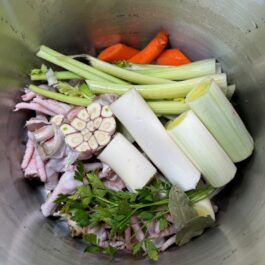
A mix of leftover or uncooked bones, approximately 4 lbs (2 kg)
- chicken feet
- chicken carcass bones, from whole roast chicken
- pork rib rack bones, from pork rib roast
- ribeye or porterhouse bones
- pork bones
Additional Flavor Contributors
- 4 cloves garlic, peeled
- 1 leek, rough chop
- 1-2 stalks of celery, rough chop
- 10 coriander seeds
- 10 white or black peppercorns
- 2 bay leaf
- water, enough to cover the bones by 1 inch
Equipment
- 1 large pot at least 12 liters
Instructions
- Remove any excess fat from bones.
 In a large pot place all of the ingredients.
 Fill the pot with water to that it covers the ingredients with 1 inch of water (2 cm). In this instance the water filled to the 9.5 liter line on our pot.
- Place the pot on the stove and heat over high heat until boiling.
- Once boiling, reduce the heat to medium so that there is only light bubbling (simmer). Cook the stock for 4-5 hours.
- If any ingredients become exposed add additional water to cover with 1 inch of water. This may be necessary 2 to 3 times, so keep an eye on the stock as it cooks.
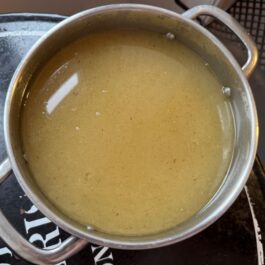 Once the time has completed the stock should be a beautfiul golden cloudy color.
- Remove the stock pot from the heat. Strain the stock through a fine mesh sieve into another large pot or large bowl.
- At this point you can pour into smaller pint sized containers, ice cube trays or keep in the bowl and cover with saran wrap. If you plan to use within the next week you can keep in the refrigerator. For longer term use store in the freezer.